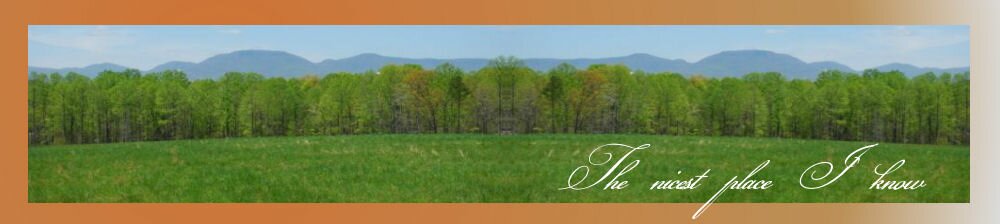
'Campo Bella' ..... Beautiful Field
|
 |
Nestled in the gentle rolling foothills of the Piedmont and surrounded by peach and apple orchards, Campobello is a town with a population of 469 residents located in the northwestern area of Spartanburg County three miles from Interstate 26 at exit 5. Other major highways traveling through Campobello are U.S. Highways 176 and 357 as well as scenic Highway 11.
From the meager description of land boundaries, and sometimes not even listing the number of acres with a given tract or parcel, dates sold, etc. it is difficult to determine who were the first owners of land that is now Campobello. Early county records indicate Isaiah Bowling transferred 164 acres in 1818 to Joseph Davis. In 1826 Mr. Davis acquired 150 acres from Abram Brock, an additional 50 acres in 1827 as well as 80 acres that did not have a specified date. In 1872 he purchased a tract of land, size unspecified, from F.J.F. Wall.
|
|
Many years before the Civil War Joseph Davis' children Mary Davis Dean and John Blankston Davis operated the large family farming interests along the South Pacolet River. Part of this plantation forms a portion of present day Campobello. Mrs Dean, a young widow, would ride up to their plantation on horseback from Spartanburg where she resided with her daughter, Lula, to keep an eye on the plantation's activities. One day Mrs. Dean and friends were riding from Spartanburg and upon reaching the top of Windmill Hill, stopped, dropped the horse's reins and someone in the group exclaimed, "Campo Bella" meaning 'beautiful field'. The name caught on and the plantation home of her brother, John Blankston Davis, became known as Campo Bella.
A room in Mr. Davis' plantation home was designated as the area post office. After the Civil War this practice continued and it became known as the U.S. Post Office for Campobello receiving mail once each week on Fridays. Upon its official incorporation into a municipality on February 9, 1882 the town was officially known as Campobello. The name change most likely occurred due to the poor penmanship of a postal clerk of the day.
The 1860 Census indicated that "Campobella, SC" had a total of 122 residents in the Township. Employment at the time of the 1860 Census showed 15 of the 18 households were farmers. At the end of the Civil War the U.S. Census listed the population in the Campobello community as 21 families and 201 persons.
On May 7, 1870 a meeting was held in Campobello at Copeland's Store for the purpose of electing the first trustees for School District One. The election resulted in naming Stafford Hall, J.A. Foster and Merdia Lanford as the District's first trustees. Old records indicate that M.H. Reid was named to teach in the Campobello Township for District One.
The People's Bank - Campobello, South Carolina
|
|
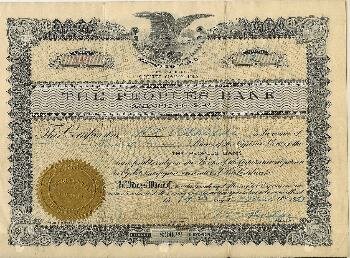
1921 Bank Bond
|
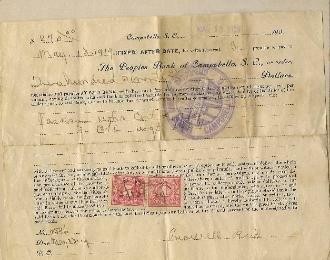
1919 Bank Note
|
During World War I portions of Campobello around Caldwell and Depot Streets were designated as a staging area for the U.S. Army and a tent city for the troops soon appeared. Recruits were housed in tents in town and they traveled down Highway 11 to Gowensville to their artillery and small arms firing ranges to learn to use their weapons before being sent to the front lines of the war.
The Town Hall and Police Department are located on Main Street in a structure that was originally built in the late 1940's to be used as a doctor's office which served the local residents of the area. No records indicate how long the doctor used the facility however the next occupant was AgriChem. The building was used as a sales office to sell farming chemicals to the local farmers. In 1956 the town organized a volunteer fire department and after many fund raising activities enough money was collected to purchase their first fire truck. The building, which was available, was renovated by lowering the floor on one side of the structure to street level and pouring a concrete slab so the fire truck could be housed in the building. The house directly across the street had telephone service. When there was a fire call the owners would take the message and go outside to set off the fire bell located on their front porch. Over the years the home has been sold and remodeled several times so there is no longer any sign that it was once used for what we would
refer to today as a 911 emergency center.
|
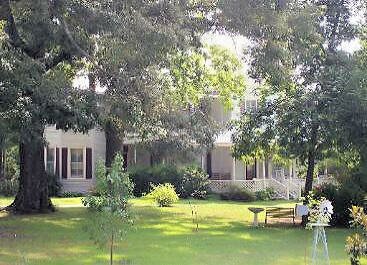
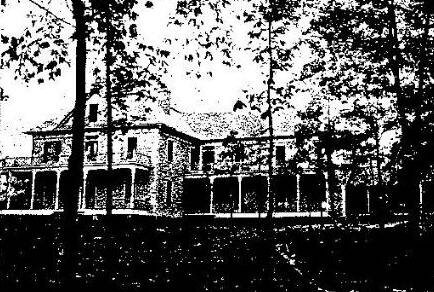
No records exists to indicate when the Victorian house on
Caldwell Street was built in the late 1800's. The home was
called 'The White House' at the time Col. William C.
Coleman, chief engineer, on the railroad, resided there due
to the large influx of guests visiting the Coleman family.
The Rev. I. W. Wingo and family lived in the home which
also served as a girl's dormitory for a new school he was
establishing. In 1906 Captain R.B. Monk purchased the
home to use as his personal residence.
|
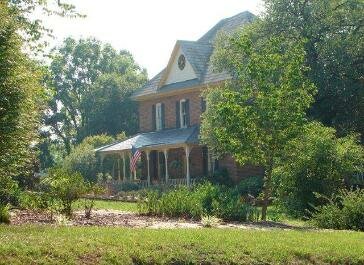
Built from bricks made on site by boys attending school
along with local workers the school was the vision of Rev.
I.W. Wingo. In appreciation of debts paid off by Captain
R.B. Monk, the citizens of the community named the school
'The Monk Institute' which opened September 17, 1906.
|
|
|
|
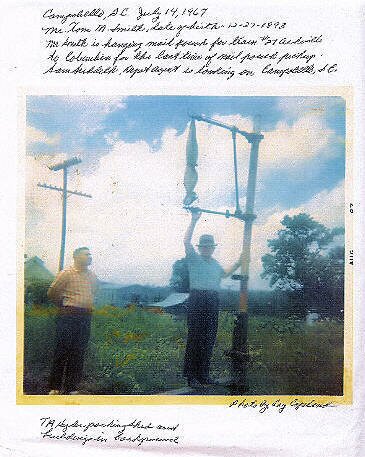
July 14, 1967
Campobello, South Carolina
Mr. Tom M. Smith (date of birth 12-27-1893).
Mr. Smith is hanging the mail pouch for
train number 27, Asheville to Columbia, for
the last time for mail pouch pick up.
Looking on is Sam Suddeth, Depot Agent.
T.A. Hyder packing shed and out building in
the background. |
|